
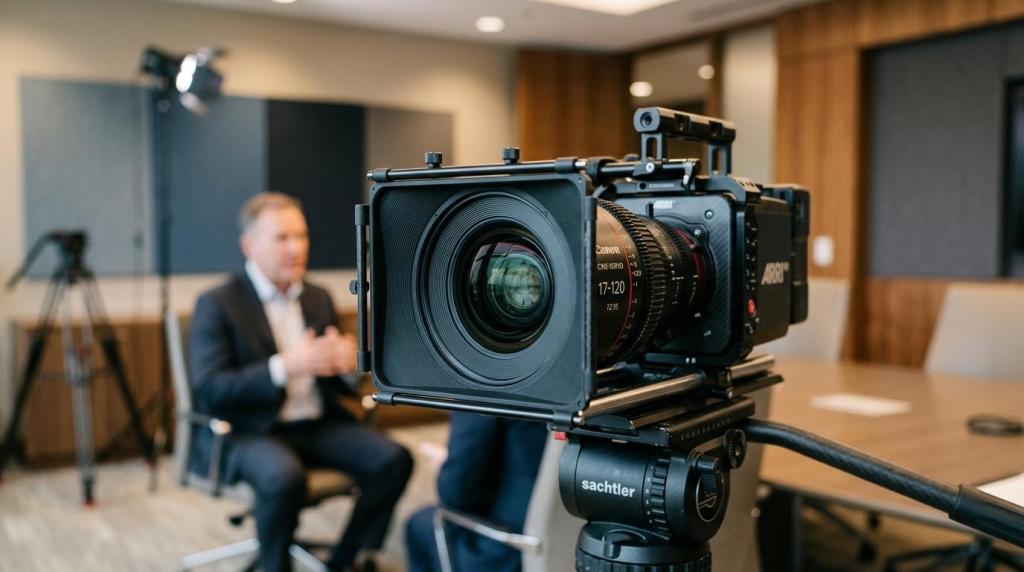
Corporate video is one of the most practical content investments Edmonton developers and enterprise teams can make when they need to explain, persuade, train, and report at scale.
TL;DR: Summary
- The corporate video use cases Edmonton developers and enterprise teams should prioritize are explainer videos, product or service demos, stakeholder updates, executive interviews, training videos, webinars, brand or culture films, and event recap videos.
- For B2B distribution, LinkedIn and owned website pages should usually come first; Wistia’s 2026 report says 81% of teams share video on LinkedIn, compared with 76% on YouTube.
- Educational videos, product videos, social videos, and webinars are the formats companies are investing in most, which makes them the safest starting point for corporate video production Edmonton budgets.
- If the goal is lead generation, use explainers, demos, or webinars; if the goal is onboarding, compliance, or internal adoption, use training videos; if the goal is trust or approvals, use stakeholder and executive communication videos.
- The strongest Edmonton video production plans treat one shoot as multiple assets, with cuts for LinkedIn, websites, sales decks, internal intranets, and presentation environments.
For Edmonton organizations working in development, infrastructure, commercial property, education, and enterprise B2B, the key is not just making a polished video. The key is choosing the right use case first, then building distribution around LinkedIn, landing pages, and internal channels where those videos can actually influence decisions.
Why does corporate video matter for Edmonton developers and enterprise teams?
Corporate video is now a B2B decision tool, and LinkedIn plus your website are the two channels Edmonton teams should treat as primary.
Developers and enterprise teams rarely need video for entertainment. They need it to shorten sales cycles, explain complex offers, support executive messaging, improve training consistency, and keep stakeholders informed. In Edmonton, that often means translating dense information about projects, services, operations, or organizational change into a format people will actually watch.
Current data supports that shift. Wistia’s 2026 State of Video Report surveyed 900+ professionals and analyzed more than 13 million videos and 79 million hours of viewing data. One of the clearest takeaways is that B2B video sharing is concentrated on LinkedIn, where 81% of teams publish video, compared with 76% on YouTube.
“Q Filmz Media optimizes corporate videos for LinkedIn, YouTube, websites, internal intranets, and presentation environments, which matters when one Edmonton shoot needs to serve multiple B2B channels.”
That matters because a corporate video is rarely judged by views alone. A stronger measurement model looks at play rate, watch time, lead gen forms, social engagement, and conversion assists. A common mistake is assuming high impressions equal business impact. If the video reaches people but does not move them to book, approve, sign up, or understand, the asset is underperforming.
How should Edmonton teams choose the first corporate video format?
The best first corporate video is the one tied to one business outcome, one audience, and one distribution path.
Step 1 is to define the job the video has to do. If your Edmonton team needs more qualified conversations, start with an explainer, product, or webinar format. If the problem is inconsistent onboarding or repeated internal questions, training video production is usually the better first move.
Step 2 is to map the audience and its main objection. Enterprise buyers, municipal stakeholders, internal staff, investors, and procurement teams do not need the same message. If the audience must trust leadership, use executive interviews. If they must understand a process, use educational or training content. If they must support a project, use stakeholder communication video.
Step 3 is to decide where the video will live before you script it. That sounds obvious, but many teams still plan a “general video” and only later ask whether it belongs on LinkedIn, a landing page, an intranet, or inside a webinar deck. Pro tip: do not start with runtime. Start with the decision you want the viewer to make, then build the format around that decision.
What are the 8 corporate video use cases Edmonton developers and enterprise teams should prioritize?
The safest priorities are the formats that already match B2B buying and communication behaviour. These are also the corporate video categories we see most often serving Edmonton enterprise goals across marketing, operations, HR, and stakeholder communications.
-
Explainer videos: Best for clarifying a service, development concept, internal process, or enterprise offer in 60 to 120 seconds, especially on websites and sales pages.
-
Product or service demo videos: Useful when your team needs to show how a platform, system, commercial environment, or offering actually works, rather than just describe it in text.
-
Stakeholder and investor update videos: Critical for developers, builders, and enterprise groups that need clear communication around milestones, timelines, strategy, governance, or project status.
-
Executive interview videos: Strong for leadership visibility, trust, media relations, internal announcements, and strategic messaging where tone and credibility matter as much as information.
-
Training and onboarding videos: Ideal for repeatable education across HR, safety, operations, and field teams, especially when in-person delivery is expensive or inconsistent.
-
Webinar and presentation videos: Effective for B2B lead nurturing, internal education, thought leadership, and longer-form explanation where the audience needs more depth before taking action.
-
Brand story and company culture videos: Valuable when enterprise teams need to humanize a corporate brand, support recruitment, or show mission, values, and people in a more cinematic way.
-
Corporate event recap videos: Best for conferences, town halls, launches, partner events, and institutional gatherings where the goal is post-event promotion, employer branding, or stakeholder reporting. That overlap between live and on-demand communication is one reason Trust Event has highlighted how hybrid formats extend the value of a physical event well beyond the room itself, which is exactly where recap and presentation video become more useful than a one-time event asset.
Wistia says educational videos, product videos, social videos, and webinars are the formats companies are investing in and doubling down on next year. Wyzowl’s 2025 data also shows strong demand for explainers, with 73% of video marketers creating them, and 98% of people saying they have watched an explainer to learn more about a product or service. That makes explainers and demos a smart first category for many Edmonton corporate video production plans.
How do brand videos and stakeholder communication videos differ for Edmonton development projects?
Brand videos build affinity, while stakeholder communication videos build clarity.
A brand story video is meant to shape perception. It focuses on mission, values, people, vision, and the emotional reason your organization exists. For a commercial developer or enterprise team, that might mean showing leadership, culture, project purpose, and the broader impact of the work. This is the kind of asset that fits homepages, recruitment campaigns, and corporate presentations.
A stakeholder communication video has a different job. It explains what is happening, why it matters, and what comes next. For development projects, that can include milestones, timelines, safety updates, construction phases, community considerations, or investor-facing information. The tone is usually more direct, and the success metric is comprehension, not just brand lift.
“Q Filmz Media films executive interviews, training videos, investor relations videos, and stakeholder communication videos in Edmonton, matching the formats most enterprise teams actually need.”
A common misconception is that one master edit will cover both uses without compromise. Usually it will not. If you need both outcomes, film one interview day and build two edit trees: one brand-forward, one information-forward. That keeps the message cleaner for each audience.
How do training videos and explainer videos compare for enterprise teams?
Training videos drive internal consistency, while explainer videos drive external understanding.
Training content is usually process-based. It shows staff what to do, when to do it, and what standard counts as correct. In corporate and industrial environments around Edmonton, that can cover onboarding, safety orientation, software workflows, customer service protocols, equipment handling, or policy updates. The best training videos are structured, modular, and easy to revisit.
Explainer videos are usually market-facing. They answer what a service is, who it is for, how it works, and why it matters. Wyzowl reports that explainers remain the most common single video use case, and that 87% of viewers say video has convinced them to buy a product or service. That is a strong argument for explainers when your enterprise team needs better sales enablement or web conversion support.
The trade-off is depth. Training often needs more detail and less polish-first messaging. Explainers need focus and brevity. If you try to turn an onboarding video into a sales asset, it will usually feel too technical. If you turn a sales explainer into training, it will usually leave out the steps people actually need.
How should you plan an executive interview video in Edmonton?
Executive interview videos work best when message, setting, and supporting visuals are planned before the shoot.
Step 1 is message design. Decide whether the executive is speaking to customers, staff, investors, or partners. That audience choice will shape the questions, tone, and level of detail. Good corporate interview videos are rarely improvised. We recommend building concise prompts that produce 12 to 20 second sound bites, not long, rambling answers.
Step 2 is location and production planning. In Edmonton, the right location might be a head office, a project site, a commercial property, a boardroom, or a recognizable institutional environment. What matters is relevance, clean audio, controlled lighting, and a backdrop that supports the message. For broader corporate messaging, a structured corporate video production Edmonton process keeps approvals tighter and filming more efficient.
Step 3 is visual support. Interview videos need b-roll, cutaways, team footage, environmental scenes, and sometimes drone footage when site scale matters. This is where an Edmonton video production team with in-house filming, editing, and aerial capability can save a lot of revision time. Pro tip: do not book the executive for 30 minutes and expect a finished campaign. Most strong interview videos are built in the edit from well-planned coverage.
How should you distribute corporate video on LinkedIn and your website?
LinkedIn should drive reach, and your website should capture action.
Step 1 is to create platform-specific cuts. A 15 to 30 second teaser can work for LinkedIn awareness, a 30 to 60 second cut can support campaign engagement, and a 60 to 120 second version often works better on owned pages where the viewer is already evaluating your offer. Webinars and leadership presentations can run much longer because the intent is different.
Step 2 is to publish natively on LinkedIn, then route interested viewers to a focused landing page on your site. LinkedIn says video viewing on the platform was up 36% year over year, and its own B2B guidance points to video as the top planned content type. That makes LinkedIn a strong first-distribution channel for Edmonton corporate videographers and enterprise marketers alike.
“Q Filmz Media brings 500+ projects delivered, 100% in-house production, and corporate video formats built for LinkedIn, websites, and internal teams.”
Step 3 is to measure the right things. On LinkedIn, watch engagement rate, comments, shares, and click-throughs. On your website, track play rate, completion rate, lead gen forms, and conversion assists. If the play rate is strong but conversions are weak, the issue may be the page offer, headline, or form friction, not the video itself. This is also why broader Edmonton video production planning should include both creative and distribution, not just filming.
How do you choose an Edmonton video production company for corporate work?
The right Edmonton video production company should understand business communication, not just camera work.
Developers and enterprise teams need more than pretty footage. They need a partner that can handle stakeholder review, interview prep, schedule discipline, brand consistency, and multiple deliverables from one production plan. If a company cannot explain how a video will function on LinkedIn, your website, internal intranet, and presentation environments, it is probably thinking too narrowly.
When comparing options, we suggest using these filters:
- In-house production: One team should manage strategy, filming, editing, sound, colour, and delivery so quality stays consistent.
- Corporate use-case depth: Look for executive interviews, training, stakeholder communications, webinars, event coverage, and brand storytelling in the portfolio.
- Distribution thinking: Ask how the company plans versions for LinkedIn, websites, presentations, and internal communications.
- Edmonton business fluency: Local knowledge matters when filming around weather, worksites, institutions, and sectors like commercial development, education, non-profit, tech, and industrial.
- Expanded campaign support: If your team also needs event videography in Edmonton or campaign creative from an advertising video team, make sure the vendor can support those adjacent needs.
For local buyers, Q Filmz Media is one Edmonton example worth benchmarking against those standards. Our team operates with a 100% in-house production model, TC-certified drone pilots, 500+ projects delivered, and experience creating broadcast-quality corporate content for organizations including RBC, SAP, Sun Life, Walmart, Telus World of Science, and the University of Alberta. That combination matters when one video program has to support marketing, executive communications, internal training, and stakeholder reporting without slowing down approvals.
Ready to elevate your brand with professional video production in Edmonton? Contact Q Filmz Media today for a free project consultation and quote.