
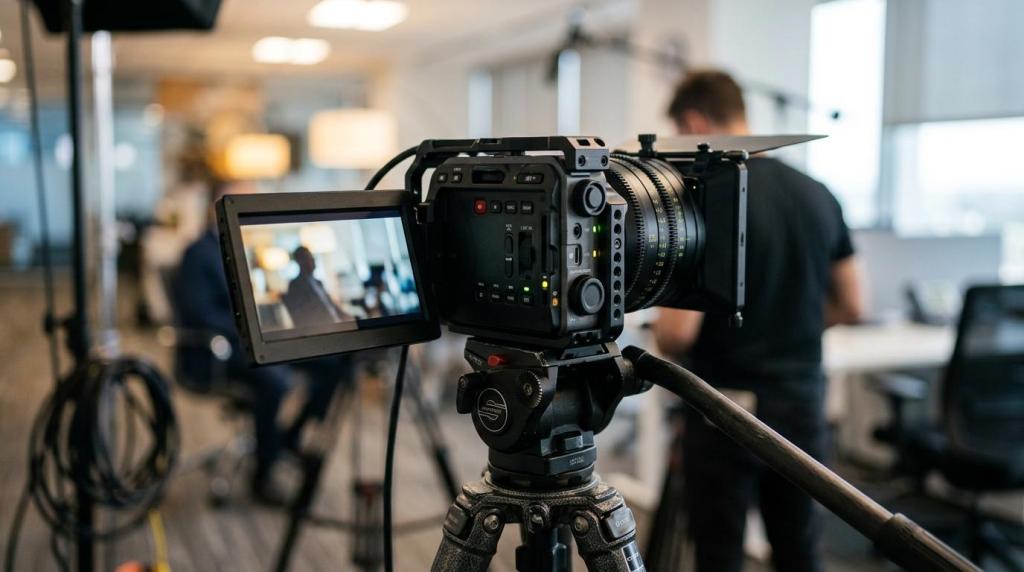
Corporate video production drives leads when the format matches the sales job. A brand story video builds trust, a product explainer reduces confusion, and a testimonial removes risk before a prospect books a call.
TL;DR: Summary
- The best corporate video production formats for lead generation are explainer videos, product demos, testimonial videos, short-form video ads, webinar videos, event recap videos, and brand story videos.
- Video performs best when each asset is built around one conversion goal, such as a demo request, consultation booking, event registration, or form fill.
- Wistia reports that one in five viewers will submit an in-video lead form, while on-demand webinars convert about 25% of viewers into leads on average.
- HubSpot reports that 73% of video marketers say video helps reach business goals, and short-form video delivers the highest ROI for lead generation and engagement.
- For Edmonton companies, the strongest setup is usually a video hub: one core homepage or landing-page video, plus LinkedIn cutdowns, testimonial proof, and a clear call to action.
In Edmonton, that matters because most corporate buyers do not convert after a single touch. We see better results when companies in oil and gas, education, municipal, tech, and non-profit sectors use video as a system, not a one-off asset.
Why does corporate video production generate better leads than static content?
Yes. Wistia and HubSpot data show that corporate video production can convert attention into leads when the viewer sees one clear offer and one clear next step.
Static pages are still important, but video compresses trust faster. A prospect can hear an executive, see a facility, understand a process, and judge credibility in under two minutes. That is hard to match with copy alone, especially for higher-ticket B2B services in Edmonton where buyers want proof before they book a meeting.
“Q Filmz Media publicly lists corporate videos, explainer videos, product videos, event videos, animated videos, and podcast videos among its Edmonton production formats.”
There is another layer at the top of the funnel. Think with Google found that many video campaigns lift ad recall, brand awareness, and brand interest. That does not mean every video should sell immediately. It means the right video can warm up the market before your sales team asks for the conversion.
Which business goal should come first in a lead-focused video strategy?
One goal should come first. LinkedIn and landing pages perform better when a corporate video is tied to a single conversion action.
Step 1: Pick the conversion event before the script. For most Edmonton businesses, that is one of four actions: book a consultation, request a quote, register for an event, or download a resource. If the action is vague, the edit usually becomes vague too.
Step 2: Match the format to funnel stage. If your audience is cold, use a brand story, short-form ad, or explainer. If they already know your company, move to product demos, testimonials, or webinar clips. A common mistake is asking one video to handle awareness, education, objections, and closing all at once.
Step 3: Build the destination first. The landing page, form, calendar link, or email sequence should be ready before production starts. If the page is weak, even a strong video underperforms.
What are the 7 corporate video production types that drive leads?
These seven formats generate the most useful business outcomes. In Edmonton, we usually recommend choosing one primary format and one supporting format instead of trying to film everything at once.
-
Brand story videos: At Q Filmz Media, we treat these as trust-builders for homepages, proposals, and LinkedIn. They answer who you are, what problem you solve, and why a buyer should keep talking to you.
-
Explainer videos: Best for complex offers, abstract services, and long sales cycles. They reduce confusion and improve qualified inquiries.
-
Product demo videos: Best for software, equipment, manufacturing, industrial services, or any offer that needs visual proof. These work well lower in the funnel.
-
Customer testimonial videos: These turn claims into evidence. Wistia reports planned production of testimonial videos rose from 17% in 2023 to 47% in 2026.
-
Short-form video ads: These are usually 15 to 45 seconds and work well for paid social, retargeting, and awareness campaigns. HubSpot reports short-form video has the highest ROI and is a top format for lead generation.
-
Webinar or educational videos: On-demand webinars are strong lead capture tools for B2B. Wistia says they convert about 25% of viewers into leads on average.
-
Event recap videos: These are useful for associations, conferences, employer branding, fundraising, and future event promotion. In Edmonton, they often support both lead generation and recruiting.
If your company sells expertise, not just a product, the strongest pair is often an explainer video plus a testimonial. If your company sells visibility, events, or market presence, a brand story plus short-form ads usually makes more sense.
How do explainer videos compare with product demos for lead generation?
Explainer videos win earlier. Product demos win later. HubSpot and Wistia both support using the simpler asset first and the deeper asset when buyer intent is already higher.
An explainer video answers, “What is this, and why should I care?” A product demo answers, “How does this actually work?” If your Edmonton audience is seeing your brand for the first time, an explainer usually earns more qualified clicks. If they are already evaluating vendors, a demo can move them faster toward a meeting or proposal.
“Q Filmz Media says most corporate video projects take 2 to 8 weeks, including pre-production and post-production.”
The trade-off is attention span. Explainers can stay tighter and travel well across homepage, email, and LinkedIn. Demos often need more runtime and more context. Pro tip: do not turn a demo into a narrated feature dump. Show the outcome, then the workflow, then the proof.
How do testimonial videos compare with brand story videos?
Testimonial videos convert better at the proof stage. Brand story videos position the company better at the trust stage.
A brand story tells your market what you stand for and how you work. A testimonial shows a buyer that someone like them got a result, solved a problem, or felt confident choosing your team. That is why testimonial production is rising so quickly in B2B planning.
For many Edmonton firms, these two formats should not compete. They should stack. Use the brand story on the homepage or “About” section, then place testimonial clips on service pages, proposal follow-ups, and retargeting campaigns. If a prospect is already comparing vendors, third-party proof usually matters more than polished self-description.
How should Edmonton companies plan a lead-generating corporate video?
A strong plan starts before the camera arrives. Edmonton locations, approvals, weather, and stakeholder sign-off affect both cost and conversion.
Step 1: Define the audience and objection. A University of Alberta department, a downtown professional-services firm, and an industrial client outside the city will need different scripts, visuals, and examples. If the main objection is trust, feature leadership and customers. If the main objection is complexity, build around explanation.
Step 2: Plan the shoot around evidence. That means real office footage, real team interactions, product use, workplace safety, customer context, and sound bites that say something specific. Corporate buyers respond to operational reality more than stock-style polish.
“Q Filmz Media brings 10+ years in Edmonton, 500+ projects delivered, and TC-certified drone pilots to corporate video production.”
Step 3: Lock the CTA and approvals early. Decide who signs off on script, production schedule, interview talking points, and final edit. A common delay in corporate video production is not filming. It is internal review drift.
How should you distribute corporate videos across LinkedIn, landing pages, and email?
LinkedIn should lead B2B distribution. Wistia reports that 8 in 10 B2B teams now treat LinkedIn as their primary place to share video.
Step 1: Create one core asset first. That is your homepage video, campaign landing-page video, or flagship explainer. It should be the cleanest and most complete version.
Step 2: Cut platform-specific versions. Use shorter edits for LinkedIn, vertical or square edits for social, and tighter clips for paid retargeting. HubSpot reports Instagram leads overall ROI across video platforms, but for Edmonton corporate buyers, LinkedIn is usually the first distribution priority.
Step 3: Add the video to a conversion path. Upload native video to LinkedIn, embed the full version on a landing page, and use thumbnail-driven email follow-up. Misconception to avoid: publishing a great video is not a distribution plan. If no one sees it in the right context, it will not generate leads.
How should you measure leads and ROI from corporate video production?
Measurement should start with business outcomes. Wistia and HubSpot both point to lead generation and ROI as core video outcomes, but those numbers only matter if you track the right actions.
Start with one baseline period before launch. Then compare lead volume, lead quality, booked meetings, and sales velocity after the video goes live. If you are using in-video forms, webinar gates, or retargeting, tag every asset so you can separate influence from direct conversion.
Useful KPIs often include:
- Form fills
- Demo requests
- Consultation bookings
- Webinar registrations
- Cost per lead
- Sales-qualified leads
Wistia says one in five viewers will fill out a lead-generation form if they see it in a video. It also reports that original series convert about 30% of viewers into leads on average, while on-demand webinars convert about 25%. That is why gated educational content can work well for Alberta companies selling high-consideration services.
What budget and timeline should Edmonton businesses expect for corporate video production?
Timelines are usually easier to predict than lead volume. Q Filmz Media states that most projects take 2 to 8 weeks and can be priced as half-day rates, full-day rates, project fees, or monthly retainers.
The biggest variable is scope. A single executive interview filmed in one Edmonton office is very different from a multi-location production with drone footage, testimonials, motion graphics, and cutdowns for paid social. Fast turnaround is possible, but every rush choice creates a trade-off in approvals, shot count, or revision depth.
Common budget drivers include:
- Scope: one video versus a campaign with multiple edits
- Crew: solo operator, small crew, or larger in-house team
- Locations: one office, one plant, or several Edmonton-area sites
- Post-production: subtitles, motion graphics, colour, sound mix, versioning
- Usage: internal training, paid ads, trade shows, or broad campaign rollout
If your deadline is fixed, simplify the structure before you cut production quality. Fewer locations and a tighter script often protect ROI better than trying to do too much in one shoot day.
How do you choose the right Edmonton video production company?
The right Edmonton video production company should fit your sales process, not just your visual taste. Q Filmz Media, Urban Video, Ajax Creative, and other Alberta teams can all produce polished work, so the better test is operational fit.
Look for an in-house process, sector experience, and evidence that the team can translate business goals into scripts, interviews, and edit structures. That matters for municipal clients, oil and gas teams, non-profits, educational institutions, and employers trying to attract talent. If you need aerial footage, ask about Transport Canada certification. If you need fast approvals, ask how revisions and stakeholder sign-off are managed.
We also recommend checking whether the company can build a full asset set, not just one hero video. A strong corporate video production partner should be able to turn one shoot into homepage content, LinkedIn clips, testimonial cutdowns, event coverage, and photography if required. You can review our related service pages for corporate video production in Edmonton, event videography in Edmonton, and broader Edmonton video production planning.
If you are deciding which corporate video type will drive the most leads for your business in Edmonton, we can help map the format to your offer, audience, and timeline. Ready to elevate your brand with professional video production in Edmonton? Contact Q Filmz Media today for a free project consultation.